

Grande-île and Neustadt Walk
With this short walk, embark on a journey to discover the Strasbourg site inscribed on the UNESCO World Heritage list!
By way of introduction...
An outstanding urban heritage: the blended influences of Grande-Île and the Neustadt.
Strasbourg bears witness to the many influences that have changed the shape of the city over the ages, from the original Roman camp, through the mediaeval urban layout and up to the great city of the 19th and 20th centuries. They have also had a profound effect on its architectural heritage, with its strong Rhenish inspiration blending in with buildings of French influence and the historicist and eclectic architecture of the German period. Grande-Île and Neustadt together form an outstanding example of historically adventurous urbanism.
The initial property, inscribed in 1988 on the World Heritage List, was formed by the Grande-Île, the historic centre of Strasbourg, structured around the cathedral. In July 2017, the extension concerns the Neustadt, new town, designed and built under the German administration (1871-1918). This extension sets out to document, protect and raise awareness of the exchanges of influences and the historical coherence of the city’s built environment.
Throughout its long history, Strasbourg has successfully adopted successive legacies, while developing a strong identity of its own.
Stop 1
Place du château
The buildings around the square (Place du Château) reflect three significant periods in the history of the city’s architecture. The Cathedral and the left wing of the Oeuvre Notre-Dame (1307) date from the Gothic period, while the right wing (1580) shows a strong Renaissance influence. The Palais Rohan is characteristic of 18th-century French architecture.

Stop 2
The Cathedral
The Cathedral is an outstanding example of 13th century French Gothic architecture.
The spire, completed in 1439, is a masterpiece of technical prowess, and was the highest in the country until the 19th century.

Stop 3
Rue des hallebardes
Rue des Hallebardes runs along what used to be a Roman thoroughfare and the main commercial road of the Roman camp, the Argentoratum which was built in around 12 BC.
Stop 4
Hôtel de Hanau-Lichtenberg, current City Hall
The Regency-style Hôtel de Hanau-Lichtenberg – the current City Hall – was built on the orders of Johann Reinhart III of Hanau-Lichtenberg, to the same pattern as the administrative buildings in Paris, a horseshoe design built around a courtyard.

Stop 5
The opera
The old municipal theatre and current opera was built in 1821 in Neoclassical style.
Its extension to the rear was designed by Johann-Carl Ott in 1888 and helped link the historical centre to the Neustadt.

Stop 6
Place de la République
Connected by a broad avenue to place Broglie, place de la République was built during the German period (1871-1918) and constituted the new political and administrative centre of the city, with a number of official buildings in historicist and eclectic style.

Stop 7
The Imperial thoroughfare
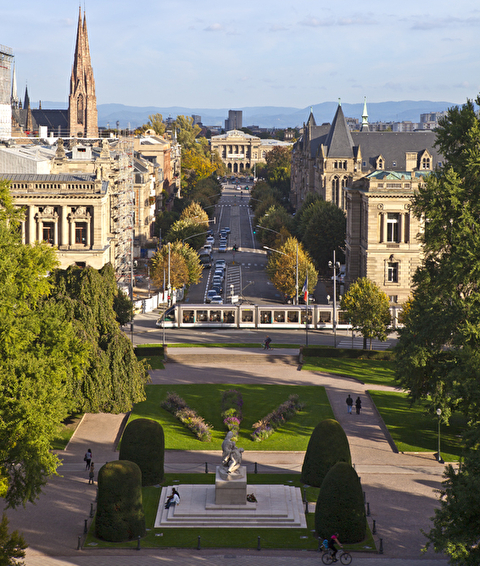
Kaiser-Wilhelm-Strasse (avenue de la Liberté, an Imperial thoroughfare) provided the bac drop for prestigious ceremonial events and provided a direct link between the Palais du Rhin, the imperial residence, and the main University building, the Palais Universitaire.
Stop 8
St Paul’s Church
St Paul’s Church was built between 1892 in 1897 by architect Louis Moller to be used as the Protestant garrison church.
Its Neo-Gothic style was influenced by the 13th century St Elizabeth’s church in Marburg, Germany.

Stop 9
The palais universitaire
The Palais universitaire forms the heart of the new Imperial University. Built between 1879 and 1884 by the architect Otto Warth, the building is an architectural gem inspired by the Italian Renaissance. Its 125-meter façade recalls the Dresden Painting Gallery, adorned with statues of scholars, symbols of knowledge. Two emblematic statues, Argentina and Germania, reinstalled in 2014, symbolize Franco-German reconciliation.
The building is organized around a vast central aula, around which the classrooms are arranged. As the building’s nerve center, it hosts ceremonies and events, continuing a centuries-old tradition.

Stop 10
The municipal baths
The architecture of the municipal baths espoused the Bund für Heimatschutz movement, which drew inspiration from regional tradition.
The entrance rotunda is reminiscent of a late 17th century monumental building and contributes to the majestic character of the building.


Fancy another discovery tour ?
This tour was developed by the 5e Lieu